
Duplex vs Austenitic Stainless Steel: 316L vs 2205 vs S32750 Selection Guide for Piping Applications
Published: 2026-08-06 Views: 135
Comparing corrosion resistance, strength, cost, and applications to help you specify the right grade
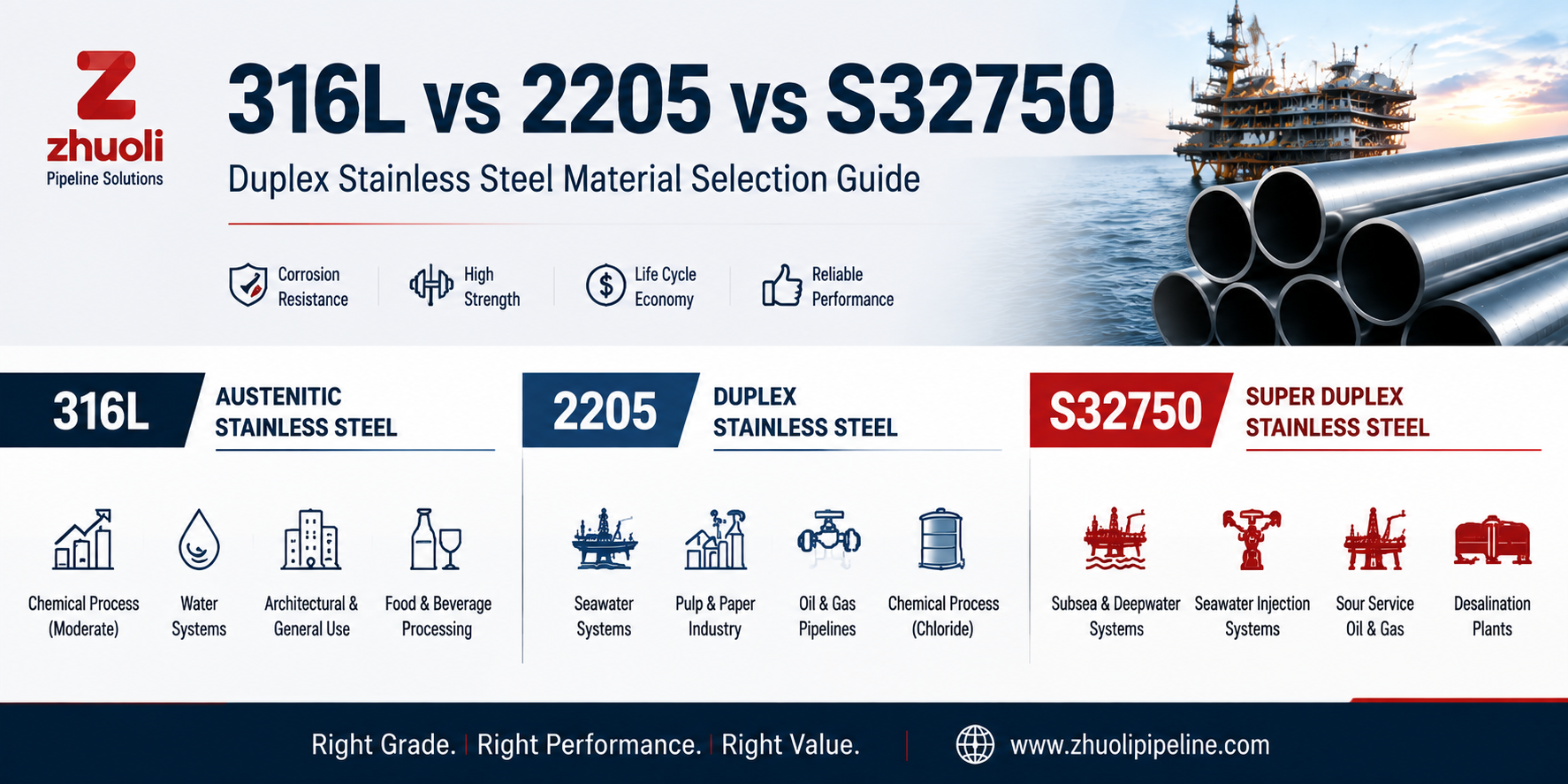
For offshore, chemical, LNG, and process piping applications, choosing between austenitic stainless steel and duplex stainless steel directly impacts reliability, maintenance cost, and lifecycle performance. For pipeline applications, the choice often narrows to three families: austenitic (304/316L), standard duplex (2205), and super duplex (S32750). This guide compares these grades across the key decision factors to help engineers and buyers make informed specifications.
Austenitic vs Duplex Stainless Steel: Microstructure Difference
Austenitic stainless steels (304, 316L) have a single-phase face-centered cubic (FCC) microstructure, which provides excellent formability, weldability, and toughness. microstructure, usually targeted around 40–60% ferrite depending on grade and processing condition, combining the high strength and stress corrosion resistance of ferrite with the toughness and corrosion resistance of austenite.
Corrosion Resistance Comparison
The Pitting Resistance Equivalent Number (PREN) is the most widely used metric for comparing localized corrosion resistance:
Grade | UNS | Typical PREN | Pitting / Crevice | SCC Resistance | Sour Service |
304 / 304L | S30400/S30403 | ~19 | Low | Poor | Generally limited |
316 / 316L | S31600/S31603 | ~24 | Moderate | Ordinary | Generally limited |
2205 (Duplex) | S31803 / S32205 | ~35 | Good | Good | Commonly qualified |
S32750 (Super Duplex) | S32750 | ≥ 41 | Excellent | Excellent | Commonly qualified for severe environments |
(PREN = %Cr + 3.3(%Mo + 0.5W)+16%N)
In practical terms: 316L performs well in moderately corrosive chemical and atmospheric service but suffers pitting and crevice attack in warm seawater. Duplex 2205 handles seawater and brackish water reliably. S32750 is widely selected for subsea, seawater injection, and severe chloride environments where very high localized corrosion resistance is required.
Mechanical Strength Comparison
Grade | Yield Strength (MPa) | Tensile Strength (MPa) | Elongation (%) |
304 / 304L | ≥ 205 | ≥ 515 | ≥ 40 |
316 / 316L | ≥ 205 | ≥ 515 | ≥ 40 |
2205 (Duplex) | ≥ 450 | ≥ 620 | ≥ 25 |
S32750 (Super Duplex) | ≥ 550 | ≥ 800 | ≥ 25 |
Duplex grades typically provide approximately two times the yield strength of conventional austenitic stainless steels, allowing thinner wall sections and significant weight savings. This is particularly valuable in offshore and subsea systems where weight directly impacts installation cost and structural loading.
Cost Considerations
Material cost generally follows the alloying content.
Grade | Relative Material Cost |
304/304L | Baseline |
316/316L | Higher due to Mo content |
2205 Duplex | Higher alloy cost but reduced thickness possible |
S32750 | Premium alloy for severe environments |
Fabricability and Weldability Requirements
· Austenitic grades (304/316L): excellent formability and weldability; no post-weld heat treatment needed.
· Duplex 2205: good weldability with matching filler (ER2209); requires controlled heat input to preserve phase balance.
· S32750: more demanding to fabricate; requires super duplex filler (ER2594), controlled interpass temperature, and skilled welding personnel.
· All grades require pickling and passivation after welding to restore corrosion resistance.Welding procedures should maintain appropriate phase balance and corrosion resistance after fabrication.
Material Selection by Application
Environment | Recommended Grade | Rationale |
Atmospheric, water (low chloride) | 304 / 304L | Cost-effective, adequate resistance |
Chemical processing, moderate chloride | 316 / 316L | Molybdenum improves pitting resistance |
Seawater, brackish water, pulp & paper | 2205 (Duplex) | PREN ~35, high strength, cost-effective |
Subsea, deepwater, seawater injection | S32750 (Super Duplex) | PREN 40+, industry standard |
Sour service (H₂S), oil & gas | 2205 or S32750 | NACE MR0175 qualified |
Strong acids (H₂SO₄, H₃PO₄) | 904L or Ni alloy | Higher alloying needed than S32750 |
Material Selection Rules
1. Use 304/316L when corrosion conditions are moderate and fabrication simplicity is important.
2. Select 2205 duplex when higher strength and chloride resistance are needed.
3. Choose S32750 super duplex for severe seawater, subsea, and high chloride applications.
4. Always verify welding procedures, inspection requirements, and applicable standards.
Zhuoli Pipeline supplies ASTM-compliant stainless steel, duplex stainless steel, and super duplex S32750 pipes, fittings, and flanges for offshore, chemical, LNG, and industrial piping applications. Contact us NOW: commercial@zhuoli-pipeline.com .